
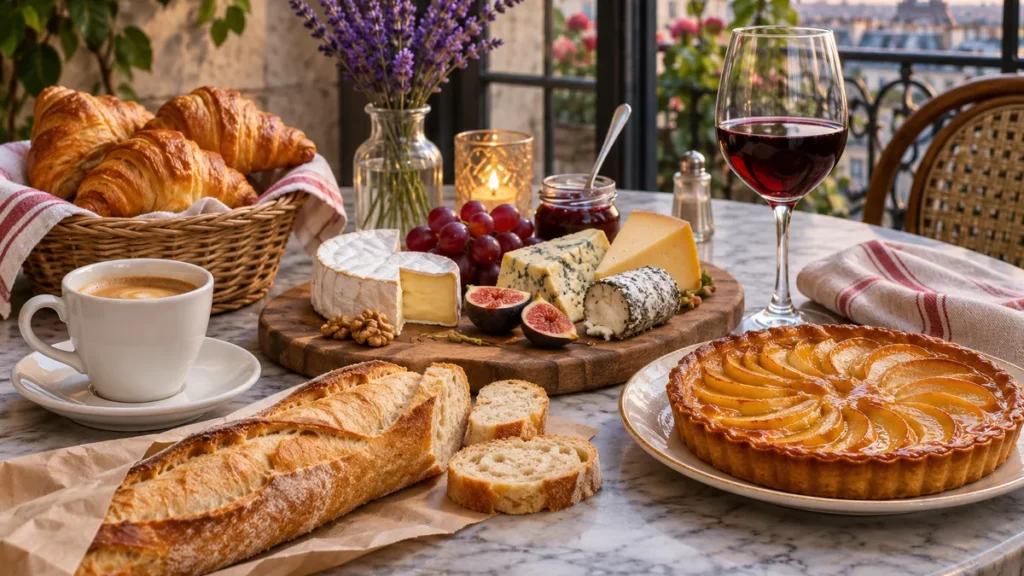

Food is at the heart of French life, so food words are some of the first you will need – at the bakery, at the market, in a restaurant or at a friend’s table. Here are the essential French food words, always with their article so you learn the gender at the same time.
In a nutshell
- Always learn a noun with its article: le pain (m.), la viande (f.).
- To talk about an unspecified quantity, use the partitive: du pain, de la viande, de l’eau, des pâtes.
- After a negation, du / de la / des become de: Je ne mange pas de viande.
🔊 Click the speaker to hear each word (your browser’s synthetic French voice).
Meals of the Day
- le petit-déjeunerbreakfast
- le déjeunerlunch
- le goûterafternoon snack – for children
- le dînerdinner
- l’apéritif (m.)pre-dinner drink – often « l’apéro »
- le repasmeal
- l’entrée (f.)starter – not the main course!
- le plat principalmain course
- le dessertdessert
Bread, Cereals and Starches
- le painbread
- la baguettebaguette
- le croissantcroissant
- les céréales (f.pl.)cereal
- le rizrice
- les pâtes (f.pl.)pasta
- la pomme de terrepotato
- les frites (f.pl.)French fries
Meat, Fish and Eggs
- la viandemeat
- le bœufbeef
- le porcpork
- le pouletchicken
- le jambonham
- le saucissondry sausage
- le poissonfish
- le saumonsalmon
- les fruits de mer (m.pl.)seafood
- l’œuf (m.)egg – pronounced [œf], plural « les œufs » [ø]
Dairy Products
- le laitmilk
- le beurrebutter
- le fromagecheese
- le yaourtyogurt
- la crèmecream
Drinks
- l’eau (f.)water
- l’eau gazeuse (f.)sparkling water
- le jus d’orangeorange juice
- le cafécoffee
- le thétea
- le chocolat chaudhot chocolate
- le vinwine
- la bièrebeer
Desserts and Sweet Things
- le gâteaucake – plural « les gâteaux »
- la tartetart, pie
- la glaceice cream
- le chocolatchocolate
- le sucresugar
- la confiturejam
Seasoning
- le selsalt
- le poivrepepper
- l’huile (f.)oil
- la moutardemustard
- la saucesauce
Tips and Common Mistakes
- L’entrée is the starter in France, not the main course as in American English. The main course is le plat principal.
- Le dîner is the evening meal. In parts of Belgium, Switzerland and Canada, le dîner means lunch and le souper means dinner.
- Don’t pronounce the final consonant of le porc [pɔʁ], but do pronounce the f of un œuf [œf].
- To order politely, say Je voudrais… rather than Je veux….
Useful Sentences
- Qu’est-ce que tu manges au petit-déjeuner ?What do you eat for breakfast?
- Je prends du pain avec du beurre et de la confiture.I have bread with butter and jam.
- Je ne mange pas de viande.I don’t eat meat.
- Je voudrais une baguette, s’il vous plaît.I would like a baguette, please.
- Comme dessert, je vais prendre une tarte aux pommes.For dessert, I’ll have an apple tart.
- Une carafe d’eau, s’il vous plaît.A jug of tap water, please.
- C’est délicieux !It’s delicious!
Quick Quiz
Choose the right French word. You get the answer immediately.
Go Further
- French shopping phrases at the market
- Markets in France
- Dialogue: cooking in French
- Fruits and vegetables in French
- Definite and indefinite articles in French
- All French vocabulary by theme
Frequently Asked Questions
What are the three meals in French?
Le petit-déjeuner (breakfast), le déjeuner (lunch) and le dîner (dinner). Children also have le goûter, an afternoon snack.
Why do the French say « du pain » and not « le pain »?
Du is the partitive article: it expresses an unspecified quantity (some bread). Le pain is used for bread in general: J’aime le pain.
What does « entrée » mean in a French restaurant?
In France, l’entrée is the starter (appetizer), served before le plat principal (main course).
